
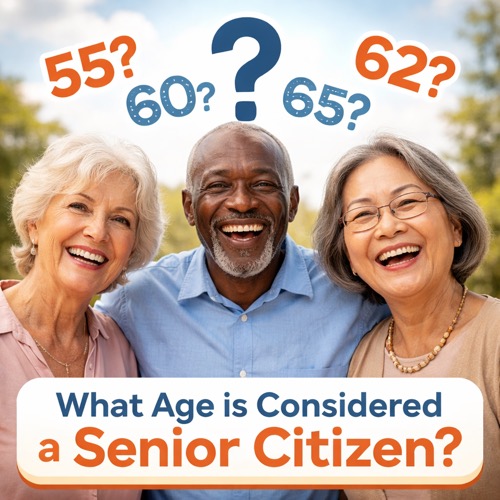
What age is considered a senior citizen? This seemingly simple question has a surprisingly complex answer. In the United States, many people associate 65 years old with “senior” status, largely because 65 is the traditional retirement age linked to Medicare and Social Security benefits[1]. However, there is no single senior citizen age that universally applies in all contexts. Depending on the program, culture, or purpose, a “senior citizen” might be defined as 60, 62, 65, or even 50 years old. In this comprehensive guide, we’ll explore the various definitions of senior age, why these age thresholds matter for benefits and services, how different countries and cultures define old age, and debunk common myths about aging. By the end, you’ll understand not only what age is considered a senior citizen in different settings, but also why age is often just a number – one factor among many in determining a person’s needs, abilities, and contributions to society.

What Age is Considered a Senior Citizen?
“At what age are you considered a senior citizen?” The answer varies. In everyday American life, turning 65 is widely regarded as the threshold of senior citizenship[1]. This general consensus stems from history: age 65 was long the eligibility age for Medicare (the federal health insurance for older adults) and was the standard Social Security retirement age for decades[2]. Hitting 65 often unlocks a host of senior benefits, from discounted movie tickets to public transit passes. Even the Merriam-Webster Dictionary simply defines senior citizen as “an older adult, especially one who is 65 or older”[3].
That said, 65 is not a hard-and-fast rule. The term “senior citizen” is a social label, not a biological rule[4]. Many people in their late 60s, 70s, and beyond remain active, working, and independent – and conversely, some in their 50s might have age-related needs. In fact, different organizations and programs use different age cutoffs for “senior” status:
- Social Security: This U.S. program historically set 65 as full retirement age, but today “full retirement age” is 66 to 67 for most, depending on birth year[5]. You can start Social Security early at 62, though your monthly benefit is reduced[6]. The age 65 remains significant because it was the original benchmark, but it’s no longer the sole standard for retirement benefits[7]. (We’ll discuss Social Security rules in detail later.)
- Medicare: 65 is fixed as the age of eligibility for Medicare, the federal health insurance for seniors[8]. With few exceptions (such as qualifying disabilities), Americans become eligible for Medicare only at 65, which is why this birthday is so closely tied to senior status in the U.S.
- Senior Discounts: Private businesses and organizations have varying definitions. Many restaurants, retailers, and travel companies offer senior discounts starting at 60 or 65. However, some perks kick in earlier – for example, certain grocery chains have “senior discount days” from age 55+, and some restaurant chains offer special menus to those 55 and older[9]. A common range for senior discounts is 55–65, depending on the company[10]. Always check, because “senior discount age” isn’t uniform – one hotel might consider you senior at 60, while another gives a break at 65.
- AARP: Notably, the American Association of Retired Persons (AARP) welcomes members as young as 50. That’s right – you can carry an AARP card while still in your 50s[11]. AARP’s early membership age often causes confusion (50 is decades shy of 65), but AARP uses this age to start offering resources and discounts to “older adults.” Despite AARP membership, most people don’t regard 50 as truly “senior”[12]. It’s simply an early-access membership age for certain benefits.
- Government & Community Programs: Many government aging services define seniors as those 60 or 62 and above. For instance, the federal Older Americans Act funds community programs (meals, senior centers, etc.) that typically serve adults 60+. In some states, 60 is the official age to qualify for state-level senior services[13]. Some communities designate 62 as the cutoff for senior housing or local tax relief. For example, in Florida many senior services and even a Senior Farmers’ Market Nutrition Program begin at age 60[13]. Meanwhile, 62 is significant in various programs: it’s the minimum age for federally subsidized “senior” housing in many cases, and it’s the eligibility age for the U.S. National Park Service Senior Pass (a lifetime parks pass available to those 62+)[14].
- Legal Definitions: In U.S. federal law, there isn’t a single definition of “senior citizen” applicable everywhere, but some laws set specific ages. For example, the Age Discrimination in Employment Act protects workers 40 and older from age-based job discrimination – a reminder that “older” can even mean 40+ in certain legal contexts[15]. On the other hand, some federal statutes explicitly define “senior” as 65+ for their purposes. (A transportation law, for instance, defines a “senior” as an individual 65 years or older[16], which aligns with the common retirement age.)
As we can see, what age is considered a senior citizen depends on who’s asking and why. It spans a spectrum from 50 (AARP’s threshold) to 65 (Medicare and the prototypical retirement age), with other key ages like 55, 60, and 62 in between. For most social and commercial purposes, turning 65 remains the most recognized milestone of senior status in the U.S.[1]. But context is everything – a 60-year-old might be a “senior” at a community center but not yet for Medicare, whereas a 55-year-old could get a senior discount at one store but not another.
Importantly, age is just one way to define a senior, and an imperfect one at that. Some 70-year-olds run marathons, while some 60-year-olds have serious health conditions. Recognizing this, many senior service providers focus on needs rather than an exact age. For example, home care agencies emphasize that a person’s functional status – not their birth date – determines if they need assistance at home[4][17]. In short, being a “senior citizen” is as much a social designation as a chronological fact.

55, 60, 62, 65 – Which Milestone Marks the Senior Age?
You might notice a few ages keep coming up: 55, 60, 62, and 65. These are common milestones at which different “senior” benefits kick in. Here’s a quick rundown of what each age can mean:
Age 55:
This age often marks the start of early senior perks. Many private businesses begin offering senior discounts at 55, such as certain restaurant chains with a 55+ menu or retailers with special discount days[9]. Age-restricted retirement communities frequently set 55 as the minimum age for at least one resident (sometimes called “55+ communities”). At 55, you won’t qualify for Medicare or Social Security yet, but you might start enjoying cheaper coffee or movie tickets. In essence, 55 is a common threshold in the private sector for “senior” marketing, even though it’s a decade before traditional retirement age.
Age 60:
This is a key age for government and community programs. The Older Americans Act and many state programs use 60+ to define the senior population for services like home-delivered meals, senior centers, and transportation assistance[13]. For example, a county dial-a-ride service might be available to residents 60 and over. Some national organizations, like AARP, also start certain programs at 60. In many cultures worldwide (including United Nations discussions), 60 is often used as a general benchmark of “older adult” status. While 60 may not bring new federal benefits in the U.S., it’s widely used in the context of “aging services” and is a common cutoff for research and policy on seniors.
Age 62:
This age is significant primarily due to Social Security. 62 is the earliest age you can start drawing Social Security retirement benefits in the U.S.[6]. Many Americans do claim benefits at 62, albeit with a reduction in the monthly amount (around 25–30% less than if they waited until full retirement age). Age 62 is also when other benefits become available: for instance, the U.S. National Park Senior Pass (lifetime access to national parks at a one-time fee) can be purchased upon turning 62[14]. Some pension plans and senior housing complexes use 62 as a qualifying age as well. In short, 62 is often considered the beginning of retirement eligibility, even though it’s “early retirement.” It’s a transitional age where one foot steps into senior status (early Social Security, some housing options), while other benefits (Medicare) are still a few years away.
Age 65:
This is the classic senior citizen age in America. Reaching 65 traditionally meant one was a full-fledged senior, retiring from work and enrolling in Medicare. Medicare eligibility begins at 65[8], providing health insurance to older adults. Although Social Security’s full benefit age is now slightly higher, 65 remains the age most closely associated with being a “senior citizen” in the public consciousness[1]. Many senior discounts, from Amtrak fares to national park entrance fees (with a Senior Pass annual option), are available at 65 if they weren’t already sooner. In many other countries too, 65 has been a common retirement age (though this is changing). Culturally, 65 is when one is undeniably considered an “older adult.” It’s no surprise that many gerontologists and policymakers use 65+ as the default definition of the “senior” population in statistics[18].
Beyond 65:
Ages 66–67 are now the Full Retirement Age (FRA) for Social Security (for those born after 1954)[5]. That means by 66–67, you can collect 100% of your earned Social Security benefit. Age 70 is another milestone, as it’s the latest age to start Social Security – waiting past 70 doesn’t increase benefits further. Many Americans in their late 60s continue working; by 2022, about 24% of men and 15% of women aged 65+ were still in the labor force[19], and these numbers are expected to rise. In the private sector, a few new perks come after 65 (for example, some airlines up their senior discounts at 70). But generally, once you’ve hit the mid-60s, you’ve reached the maximum threshold for senior benefits. After that, it’s less about new privileges and more about longevity. Some laws kick in to protect very old seniors – for instance, required minimum distributions from retirement accounts now start at age 73 (as of recent U.S. law), acknowledging that by the 70s most will be drawing on retirement savings.
In summary, senior citizen age is a fluid concept. In common usage, 65+ is “senior.” But when asking “at what age are you considered a senior citizen?” you must clarify “considered by whom?” An American might say 65, a gerontologist might say 60, an employer might think 55 (for early retirement offers), and AARP will mail you membership invites at 50. All are correct in their own realm. The practical takeaway is to know the key ages for the benefits or opportunities you care about – and to remember that age alone doesn’t define any individual’s capabilities or needs.
Debunking Common Myths About Senior Age
Misconceptions about aging and “senior citizens” abound. These myths can lead to stereotypes and even policy mistakes. Let’s debunk a few common ones:
Myth: “Senior citizen” always means 65 years old.
Reality: Not necessarily – as we’ve seen, “senior” is defined variously as 60, 62, 65, etc., depending on context. While 65 is the most popular marker in the U.S.[1], someone might be considered a senior at 55 for one purpose and not until 70 for another. “Senior citizen” is a flexible category, not a strict cut-off. In everyday language we often mean retirees or those around retirement age, but there’s no universal law saying it starts at 65.
Myth: All seniors are frail and in poor health.
Reality: Older adults are a diverse group. Many people in their late 60s, 70s and even 80s live very active, healthy lives. In fact, those in the “young-old” age bracket (roughly 65–74) often report high levels of life satisfaction and health, sometimes more so than people in midlife[20][21]. It’s not unusual today to find septuagenarians running businesses, traveling the world, or even competing in senior athletic events. About 55% of Americans 65+ report their health as good or excellent, according to CDC data[22][19] (thanks to medical advances and healthier lifestyles). While aging does bring increased risk of chronic illnesses, many of those conditions can be managed so that seniors remain active. It’s true that by the “oldest-old” years (85+) there is more frailty – nearly half of those 85 and up require some assistance with daily activities[23]. But even among the 85+ group, most are living in the community (not nursing homes) and many maintain independence with minimal help[23]. The bottom line: age does not uniformly equal infirmity. There is no magic age when everyone suddenly becomes frail; individual health histories and genetics play a huge role.
Myth: Seniors are all alike (or want to be called the same thing).
Reality: The senior population is incredibly heterogeneous. A 65-year-old might be still working full-time, whereas a 95-year-old is likely retired – but even two 95-year-olds can differ vastly in health and lifestyle. The idea that all older people form one monolithic group is false. Consider demographics: seniors vary in ethnicity, education, income, and life experience more than any other age segment (because they’ve lived longer and diverged more). Even the terms people prefer vary: In a survey of Americans 55 and older, only 17% liked being called “seniors” and just 10% liked “senior citizen,” whereas the majority preferred terms like “older adult” or “mature adult”[24]. This shows attitudes within the group differ – some proudly embrace traditional labels like senior, others reject them. Lumping everyone over 60 or 65 together can be misleading; a strategy or product that suits a healthy 68-year-old may not suit an 88-year-old, and vice versa. From living arrangements to technology use to spending habits, there is wide variation among seniors. They do not all have the same needs and lifestyles – far from it.
Myth: Reaching a certain age (55, 60, 65) means you must retire and/or will automatically need help.
Reality: There is no law (in the U.S.) mandating retirement at any age – in fact, mandatory retirement has been abolished in most sectors, aside from a few exceptions. Many people choose to work well beyond the traditional retirement age. As noted, about 1 in 4 Americans 65+ remain in the labor force[19], and even at 75+, a growing number continue to work or engage in paid work in some capacity. Some seniors keep working for financial reasons, others for personal fulfillment. Likewise, needing assistance is not a given at any particular age. There’s a common phrase, “70 is the new 60,” reflecting that people are staying healthier longer. An individual’s “functional age” (health and ability level) may not match their chronological age. For example, one person at 80 might still mow their lawn and live independently, while another at 70 might use a walker and need some home care. Aging experts emphasize functional status over chronological age. As one geriatric principle puts it: “If you’ve seen one 80-year-old… you’ve seen one 80-year-old.” In other words, everyone’s aging trajectory is unique. Turning 65 doesn’t flip a switch in which you suddenly slow down – many transitions of aging happen gradually and at different times for different people. With healthier lifestyles and medical advances, dependency is often compressed to the later years of life. Many seniors remain self-sufficient until their late 80s or beyond.
Myth: Seniors are technologically illiterate and can’t learn new things.
Reality: While older adults didn’t grow up with today’s tech, they are increasingly tech-savvy. Over 75% of Americans 65–69 use the internet, and even among those 80+, internet use is rising each year (Pew Research, 2021). Seniors are the fastest-growing group of new users on platforms like Facebook. Many are quite adept with smartphones, video calls, and online banking when given proper training. Moreover, older brains can learn – cognitive aging does not mean you can’t acquire new skills. It might take a bit longer or require different teaching approaches, but seniors enroll in college courses, learn languages, and pick up hobbies (from quilting to coding) every day. The key is interest and access. Plenty of retirees relish learning in programs like Osher Lifelong Learning Institutes. And far from shunning technology, lots of seniors embrace it when it serves their needs – telehealth, for example, has high satisfaction rates among seniors; 93% of people 70+ said they are comfortable using telemedicine for doctor visits[25]. The idea that an entire generation “can’t use computers” is an outdated stereotype.
Myth: Seniors are a burden on society (and don’t contribute).
Reality: Older adults contribute enormously to society, economy, and families. Many are caregivers for spouses or even raising grandchildren. Seniors also dominate the volunteer landscape – retirees often dedicate time to charities, faith-based groups, and civic organizations. According to one report, 80% of people in their 70s engage in some form of community or volunteer work during the “summing up” phase of life[26]. Economically, seniors are consumers who spend billions annually (the “silver economy”), and many continue to pay taxes and support local businesses. Experienced seniors often mentor younger folks in workplaces or through mentorship programs, passing on valuable knowledge. It’s true that as a society ages, there are challenges (healthcare costs, pension funding), but it’s not a one-way street of dependency. In the U.S., Social Security and Medicare have significantly reduced poverty and hardship among the elderly – today the poverty rate of seniors is about 10%, down from nearly 30% in 1966[27]. Seniors as a group also vote in high numbers, contributing to the democratic process. Far from simply being a “burden,” they’re an integral part of communities. It’s more productive to view population aging as a shift to be managed, not a disaster. With more people living longer, we also have more people who can share wisdom, help in the workforce if they choose, or volunteer. Societies that find ways to engage seniors (in part by dispelling these myths) reap benefits from their skills and time.
By challenging these myths, we promote a more age-inclusive society. Aging is a natural process – not an ailment – and seniors are individuals with varied abilities and preferences. Understanding the facts about senior age helps policymakers, businesses, and families make better decisions, whether it’s designing senior-friendly products, crafting fair retirement policies, or simply treating older folks with the respect and opportunities they deserve.
What Age Qualifies Seniors for Federal Programs and Senior Benefits?
Age isn’t just a number when it comes to qualifying for important programs – it’s often the key that unlocks healthcare, income support, and special services for older adults. In the United States, several major federal programs and benefits specifically use age cut-offs to determine eligibility. Here we break down the ages at which seniors qualify for the “big three” – Medicare, Social Security, and various senior discounts – as well as other age-based programs.
Medicare Eligibility: When Seniors Qualify
Medicare is the national health insurance program for older Americans, and reaching 65 is the golden ticket for entry. Eligibility for Medicare begins at age 65 for U.S. citizens and permanent residents[8]. This applies regardless of income or employment status. You can think of it as an automatic benefit of turning 65 – in fact, most people are enrolled in Medicare Part A (hospital insurance) automatically when they start Social Security, or they sign up around their 65th birthday if not yet receiving Social Security.
There are a few exceptions to the age 65 rule: – Individuals who have been on Social Security Disability Insurance for 24 months become eligible for Medicare before 65. – Those with end-stage renal disease (permanent kidney failure) or ALS can qualify at any age.
But for the vast majority of Americans, 65 is the magic age for Medicare. At 65, you can enroll in: – Medicare Part A – Hospital Insurance (typically premium-free if you or a spouse paid Medicare taxes for at least 10 years). – Medicare Part B – Medical Insurance (outpatient/doctor coverage, which has a monthly premium). – Medicare Part D – Prescription Drug coverage (offered through private plans). – Or choose a Medicare Advantage (Part C) plan, which bundles A+B (and often D) through a private insurer.
It’s crucial to sign up during your initial enrollment window around age 65 to avoid late penalties[28]. This window starts 3 months before the month you turn 65 and ends 3 months after. Missing it can result in higher premiums later, unless you have other creditable coverage (like through an employer).
For low-income seniors, turning 65 may also open doors to programs like Medicaid for aged individuals, or Medicare Savings Programs that help pay Medicare premiums[29][30]. Many such assistance programs use 65 as a qualifying age in line with Medicare.
It’s worth noting that Medicaid, the joint federal-state program for low-income people, doesn’t have a universal age requirement – younger adults can get Medicaid too. But there are Medicaid pathways specifically for seniors (age 65+) who need help paying for things Medicare doesn’t cover (like long-term care in a nursing home). So age 65 can also be when some seniors transition from regular Medicaid to an “aged 65+” category of Medicaid with different rules.
Why 65? When Medicare launched in 1965, 65 was chosen as it aligned with Social Security and covered about 95% of the retirement-age population. That has remained, even though average life spans have increased. There have been discussions about possibly raising Medicare’s eligibility age (to 67 for instance) to match Social Security’s full retirement age, but as of now, 65 stands firm.
To summarize: – If you’re turning 65, it’s time to think about Medicare. You’ll qualify that year for comprehensive health insurance coverage. – There’s no Medicare for 60 or 62 (common misconception). Social Security might start at 62, but Medicare doesn’t until 65 (except disability cases). – Once on Medicare, seniors often find health costs more manageable, though many buy Medigap supplemental insurance or have retiree insurance to cover what Medicare doesn’t.
Bottom line: Age 65 is Medicare Day for American seniors – a hugely important milestone for healthcare security[8].
Social Security Benefits: Early vs Full Retirement Age
The Social Security Administration (SSA) uses a few key ages to determine retirement benefits for seniors. Unlike Medicare’s single age, Social Security has a range: – 62 – Earliest eligibility for retirement benefits (often called early retirement age). – 66 to 67 – Full Retirement Age (FRA) for receiving 100% of your benefit, depending on your birth year. – 70 – Latest age that accrues delayed retirement credits (waiting beyond 70 yields no further increase).
Here’s how it works: Every American worker has a calculated full benefit based on their earnings record – that’s the amount you’d get if you retire at your FRA. If you claim early at 62, you can start monthly checks, but each check is permanently reduced. For example, if your FRA is 67, taking benefits at 62 means about a 30% reduction in monthly payments[31]. This reduction exists because you’re likely to receive benefits for a longer period. On the flip side, if you delay beyond your FRA, your monthly benefit increases – by roughly 8% for each year you wait, up until age 70[31]. At 70, your benefit tops out around 24-32% higher (depending on FRA).
For context: – If you were born in 1960 or later, your Full Retirement Age is 67. Born 1957? FRA ~66 and 6 months. Born 1943–1954? FRA is 66[5]. – Early retirement at 62 is available to everyone, regardless of birth year, but the reduction is steeper for those with higher FRA. – 65 (once synonymous with retirement) is now just an intermediate age. If your FRA is 66, taking benefits at 65 gives you a slight reduction (~93% of full amount). If FRA 67, at 65 you get about 86% of full amount.
Many seniors choose to start Social Security at 62 if they need the income or have health issues that might not guarantee a longer lifespan. Others wait until 66–67 or even 70 to maximize monthly income (especially if they expect to live into their 80s or beyond, higher benefits later can pay off). The decision is personal and often based on finances, health, and employment situation.
It’s important to note Social Security isn’t only for retirees at these ages: – Spouses can claim benefits based on a worker’s record (with similar age reductions for early claims). – There are also Survivor benefits and Disability benefits, which have their own rules and can be received at younger ages if one qualifies (e.g. a widow can sometimes receive survivor benefits at 60). But for one’s own retirement benefit, 62 is the minimum.
A common strategy is to claim partial benefits early to bridge a gap, or to wait until full age to avoid the reduction. Some financially secure seniors delay to 70 to get the highest possible monthly check (which can be wise if longevity runs in your family). To illustrate, the average Social Security check for a new retiree at 62 might be around $1,300, whereas at 67 it could be $1,900 and at 70 over $2,400[32] – individual amounts vary, but waiting can substantially increase the payout[33].
Also noteworthy: Social Security defines senior eligibility in some cases beyond retirement. For example, the Supplemental Security Income (SSI) program gives benefits to low-income people who are 65 or older, even if they never worked much. Here, 65 is used as a simple definition of an “aged” person for welfare benefits (though one can get SSI earlier if disabled). This again shows 65’s enduring role in federal policy.
In summary, for Social Security retirement: – 62 = you can start (the door opens, with smaller checks)[31]. – 66–67 = you get your full entitled benefit (no reduction)[5]. – 70 = no reason to wait longer; this is the peak beyond which checks don’t increase further.
Every senior should carefully consider when to claim. The program is structured so that, on average, a person gets roughly the same total lifetime amount regardless of claiming age (early start = more smaller checks; late start = fewer larger checks). But individual circumstances (and spousal considerations) can tilt the decision.
Importantly, Social Security has become a bedrock of senior financial security: about half of elderly beneficiaries rely on it for the majority of their income. Thus, understanding these age rules is crucial in retirement planning. Knowing that “at what age you’re considered a senior” by Social Security can mean 62 (early) or 67 (full) helps in setting expectations for benefit amounts and timing[5][6].
Senior Citizen Discounts: Age Thresholds
One of the perks of reaching your later years is access to a variety of senior citizen discounts. These can range from a free donut with your coffee to hefty savings on travel and entertainment. However, there’s no standard age that all companies use for discounts – it’s truly all over the map (or rather, all over the calendar). Let’s break down typical age requirements for common senior discounts:
Ages 50–55:
Thanks to AARP’s widespread influence, some businesses extend discounts to AARP members (who can join at 50). Thus, indirectly, 50 or 55 can get you deals in places that honor AARP membership. AARP members often get access to special rates on rental cars, hotels, cruises, etc., at these ages. Separately, a number of restaurants (like IHOP) and retailers have set 55 as the minimum for their senior promotions[34]. For instance, Walgreens drugstore has a seniors day for 55+ (if you’re an AARP member) or 60+ (for non-members). Michael’s craft store offers 10% off for 55+. Many buffet restaurants or fast-food chains have a senior deal starting at 55.
Age 60:
Some businesses choose 60 as the cutoff. For example, Kohl’s (a department store) has had special discounts for those 60 and over. Grocery chains sometimes offer 60+ discount days. In public services, some city transit systems give reduced fares to riders at 60+. Also, British and some European travel tours often consider 60 the start of “senior” pricing for American tourists (though this varies).
Age 62:
While not as common in private business, 62 pops up for a few notable discounts. The National Park Service Senior Pass at 62 (as mentioned) is a great benefit – for $80 you get lifetime free entry to all national parks and federal recreation lands[14]. Many state parks and recreation areas also give discounted entry or passes at age 62. Some airlines in the past offered senior fares from 62, and a few still might for certain routes. Amtrak, for example, gives a 10% discount to passengers 62 and older on most train tickets. In housing, 62 is the minimum age for “senior apartments” in many HUD-assisted rental communities, separate from the more common 55+ communities. So 62 remains a meaningful age for certain public-sector and travel-related perks.
Age 65:
This is the most prevalent age for senior discounts across the board. Many businesses that don’t have tiered or earlier senior criteria simply use 65, aligning with Medicare age. Examples: most airlines consider 65+ as seniors (if they offer senior fares at all), many hotels and car rental companies have 65+ rates or AARP rates targeting 65+. Movie theaters often give discounted tickets starting at 60 or 62, but if not, 65 will definitely get you the deal. Museums, theme parks, and tourist attractions frequently have a senior rate for 65+. Public transit in many big cities (like New York’s MTA or Boston’s MBTA) offers senior reduced fares at 65. Even some utility companies or phone companies have senior plans or fee waivers at 65. Essentially, if a discount hasn’t kicked in by 60, it almost certainly will by 65.
One complicating factor is that “senior discount” programs can change. Businesses sometimes adjust their policies, and not all advertise the discounts prominently – sometimes you have to ask. It’s always wise for seniors (or their family caregivers) to inquire about discounts when making purchases or reservations. Age verification might be as simple as showing ID, or showing an AARP card if under 65.
Also, keep in mind: – AARP Discounts: Many companies partner with AARP to give special deals to members, effectively providing senior discounts at 50+. For example, many hotel chains (Hilton, Marriott) offer a percentage off for AARP members – no matter if the member is 50 or 80. So an AARP card can function as a “senior discount card,” even though it’s not government-issued. – Local Senior Days: Beyond big brands, small local businesses sometimes designate a day of the week where seniors (often 60+) get, say, 5-10% off. Pharmacies, grocery stores, hair salons, and theaters do this in some communities. – Senior Freebies: Some public services become free at a certain age. A notable one: in certain cities, adults 65+ can get a free transit pass or free entry to municipal facilities like swimming pools. Public libraries often exempt seniors from late fees or provide free printing, etc.
In summary, senior discount age thresholds range mostly between 55 and 65[10]: – If you’re 55 or above, you can likely access a good number of discounts (especially with AARP membership to bolster). – By 60 or 62, even more doors open (parks, travel, some services). – By 65, essentially all age-based discounts are at your disposal.
It’s a nice patchwork of perks – not life-changing savings in most cases, but they can add up. A frugal senior might save hundreds of dollars a year by asking for those discounts. Just remember that each organization sets its own rules, so it pays (literally) to stay informed on the specifics.
Other Age-Based Senior Programs
Beyond Medicare, Social Security, and private discounts, there are numerous other programs and benefits that kick in at certain ages for older adults. Here are a few notable ones:
Older Americans Act (OAA) Services (Age 60+):
The OAA funds a national network of Area Agencies on Aging and local service providers. If you or a loved one is 60 or older, you become eligible for community-based services like Meals on Wheels, senior center activities, transportation to medical appointments, homemaker assistance, and caregiver support programs. These services aren’t entitlement programs (availability can depend on funding), but age 60 is the general cut-off[13]. There is no means test for many OAA services – a millionaire and a low-income senior alike can get a home-delivered meal if they meet the age and frailty criteria, though programs often target those most in need.
Senior Tax Benefits (usually Age 65+):
Many tax codes provide extra benefits once you reach 65. For example, the IRS offers an additional standard deduction for taxpayers 65 or older, which can reduce your taxable income[35]. As of 2025, this additional deduction is around $1,850 for a single filer (meaning if you’re 65+, you can deduct more than younger folks before paying taxes)[36]. Some states have property tax exemptions or reductions for seniors, commonly starting at age 65. These can significantly lower a senior homeowner’s tax bill – often there’s an application to fill out the year you turn 65 to claim the benefit. A few states use 62 or 70 for certain tax breaks, but 65 is most prevalent.
Veterans Benefits (varying ages):
U.S. military veterans often have access to benefits at younger ages than civilians. For instance, some military retirees can use base facilities or TRICARE health coverage before 65. However, one interesting age-based benefit: many states offer free or discounted hunting and fishing licenses to seniors, often defined as 65+. Similarly, some state parks have free entry or parking for veterans or seniors at certain ages.
Pension and Retirement Accounts:
Private employer pensions (for those who have them) often set their “normal retirement age” at 65, but many allow early retirement with reduced benefits by 55 or 60. If you have a 401(k) or IRA, the IRS rules allow penalty-free withdrawals starting at 59½ (not a round number, but important for retirement planning). That’s not exactly “senior citizen” age, but it’s when the government stops penalizing you for tapping retirement accounts – a recognition that people in their 60s are entering retirement. Additionally, as of recently, age 73 is when Required Minimum Distributions (RMDs) from retirement accounts must start (up from 70½ a few years ago due to the Secure Act). So in the financial realm, there are key ages in the 50s, 60s, and 70s that matter for seniors.
Public Assistance Programs for Seniors:
Certain welfare programs have senior-specific components. For example, the federal Supplemental Nutrition Assistance Program (SNAP) has slightly different income calculations for households with anyone 60 or older – making it easier for some seniors to qualify for food assistance. The Low Income Home Energy Assistance Program (LIHEAP) often treats seniors (60+) as a priority group for heating/cooling bill help. There’s also a Senior Farmers’ Market Nutrition Program (as noted in Florida’s case) providing produce vouchers to low-income people 60+[13].
Transportation and Transit:
Many public transit systems issue “Senior Passes” or IDs at 65 to allow discounted fares. A noteworthy mention: the U.S. Federal Transit Administration encourages reduced fares for seniors and defines seniors as 65+ by law[16]. That’s why 65 is commonly used by city bus and subway systems. However, a few systems use 62 or 60 as we mentioned. Additionally, programs like Access-A-Ride paratransit for those with disabilities often include many seniors (eligibility is based on disability, not age, but since disability increases with age, many participants are seniors).
Healthcare Programs:
Besides Medicare, some older people benefit from programs like PACE (Program of All-Inclusive Care for the Elderly), which is a comprehensive care program for people 55+ who are nursing-home eligible but living at home. Yes, PACE defines “elderly” as age 55 and over, highlighting again how 55 can count as senior in certain contexts of care. At the state level, there are often State Pharmacy Assistance Programs that help seniors (often 65+) with medication costs. And let’s not forget Medicaid Home and Community-Based Services waivers, which many states design to help seniors (usually 60+ or 65+) get care at home instead of in institutions.
As you can see, a lot of these programs cluster around the common ages of 60 and 65 as eligibility points. Age 60 tends to be a threshold for community/social services, whereas 65 is more common for federal entitlements and financial breaks.
It’s also worth pointing out that internationally, other countries have their own age rules: – In Canada, the Old Age Security (OAS) pension starts at 65 (with an option to defer to 70 for more money), and the Canada Pension Plan (CPP) has similar early/full/late retirement options as Social Security (standard at 65, early at 60, late to 70)[37]. – In many European countries, 65 has been standard for men (and often lower for women historically), but many are raising to 67 or higher. – Some countries have senior benefits at younger ages: e.g., in Thailand, people 60+ get a small state pension; in China, men retire at 60, women at 55 (though reforms are in discussion). So the concept of “senior programs” is global, but the ages can differ (often reflecting life expectancy and economic factors).
For a senior or soon-to-be senior, it’s beneficial to consult a comprehensive resource (like a local Agency on Aging or a benefits counselor) about “what can I get at my age?” Laws and programs do change, and new ones emerge (for instance, some U.S. states recently started offering free community college for seniors 65+ – education programs are another arena of senior benefits).
In summary, qualifying as a “senior” for benefits can happen at multiple ages: – 60 for many community and nutrition services. – 62 for some housing and the beloved National Park pass. – 65 for the bulk of federal benefits (Medicare, Social Security full retirement for earlier cohorts, tax perks). – 55 in some innovative or specialized programs (like PACE healthcare, or early retirement options).
Knowing these age triggers helps older adults and their families plan ahead – whether it’s enrolling in Medicare, signing up for a senior center at 60, or grabbing that park pass at 62. The patchwork can be complex, but it exists to support seniors through the stages of later life.
What Are the Four Stages of Aging?
Gerontologists and researchers often describe aging in terms of different stages or categories, recognizing that someone at 65 is not the same as someone at 95. You might have heard terms like “young-old” or “old-old.” One common framework splits late adulthood into three broad stages – the young-old, the middle-old, and the oldest-old. However, others talk about a “fourth age” or even use four stages of aging to capture the distinct experiences as people reach extreme longevity.
A straightforward way to define stages of older age is by chronology and typical health/functional status:
Young-Old (Ages 65–74)
Some definitions extend this up to 80. In this stage, many individuals are recently retired (or even still working), and generally active and relatively healthy. The young-old tend to be more similar to middle-aged adults in lifestyle – they often live independently, have good mobility, and engage in hobbies and travel. Researchers have noted that the young-old often experience life as the “third age” – a time of personal fulfillment after the responsibilities of work and child-rearing, but before the onset of significant age-related limitations[20]. Many in this group remain in excellent physical and mental health; for example, cognitively they perform closer to middle-aged adults than to those 85+[21]. The young-old are less likely to need long-term care or help with daily tasks – only a small minority of those in their late 60s or early 70s face severe disability. This is why we see increasing numbers of septuagenarians running organizations, volunteering, or caring for even older family members.
Middle-Old:
approximately 75 to 84. This stage is sometimes combined with young-old, but in a four-stage view it’s separated. People in their late 70s often start to experience more chronic health issues or slowing down. It’s a transitional period: many are still quite independent, but they might have given up some activities (perhaps no more mountain climbing or high-impact sports). Some in this group will start needing assistance, maybe hiring help for heavy housework or relying on family for transportation if vision has declined. Statistically, around half of people 75–84 report some form of disability (like trouble walking long distances or climbing stairs), but many of those are minor or manageable with assistive devices. This age sees an uptick in conditions like arthritis, heart disease, or hearing loss – yet medical management can often keep these issues from severely impairing quality of life. Socially, some in this stage experience life changes such as becoming widowed or downsizing their home. It’s a time where the distinction between those aging successfully and those encountering significant health challenges becomes more pronounced; there’s a wide spectrum in the middle-old group.
Old-Old:
typically 85 and older. This corresponds to what’s often called the “fourth age” of life. The 85+ population is the fastest-growing segment of seniors. Here, the likelihood of needing help with daily activities increases markedly. About 50% of the 85+ group require assistance with at least one personal care activity (such as bathing or dressing)[23]. This is the stage where frailty is common – multiple health issues, decreased mobility, and increased vulnerability to injury (like falls) or illness. Many oldest-old experience cognitive changes; the risk of dementia rises sharply with age (around a third of those 85+ may have some form of dementia). That said, it’s not all decline: a significant portion of the oldest-old still live in the community rather than in institutions[23]. Advances in assistive technology and home health services enable many 90-somethings to live at home. Also, interestingly, research shows that those who reach extreme old age often have somewhat delayed onset of diseases – so-called “survivors” or healthy agers might stay relatively well until very late, then have a shorter period of decline. Quality of life varies widely in this group; some 90-year-olds enjoy visits with family, engage in light exercise, or creative pursuits, while others may be coping with significant physical limitations. Socially, the old-old may face more isolation (outliving peers and sometimes even their children). Society is still adapting to support the needs of this stage – whether through more robust home care, age-friendly housing, or specialized geriatric healthcare.
Centenarians (100+):
Sometimes considered a separate category beyond old-old. This could be dubbed the “fourth stage” if we break it down further (young-old, middle-old, old-old, and centenarians). The number of centenarians worldwide is growing rapidly – over half a million people are now 100 or older[38]. Many centenarians enjoyed unusually good health to reach that age; studies show about 25% of centenarians had no serious chronic illnesses until after age 95[39]. They often have a genetic advantage and lifestyle factors that contributed to exceptional longevity. Those who hit 100 tend to have shorter end-of-life declines (what researchers call “compressed morbidity”)[39] – essentially, they lived healthy longer and then might experience a relatively swift health decline. While centenarians typically require care (nearly all will have some disability due to sheer age), a good number remain mentally sharp and engaged in life. It’s noteworthy that countries like Japan and Italy have high per capita centenarian counts, and in those cultures, respect for elders is strong, which may positively influence the well-being of the oldest-old. Reaching 100 is still rare enough that it’s celebrated (many get a community party or a congratulatory letter from public officials), but it’s becoming less extraordinary as medical and social conditions improve.
Another way people talk about “four stages of aging” comes from the field of life psychology. For example, gerontologist Gene Cohen proposed four developmental phases in the second half of life: Midlife Re-evaluation (around 40s–60s), Liberation (late 50s into 70s), Summing Up (late 60s–80s), and Encore (late 70s+)[40][41]. These aren’t age brackets so much as psychological stages – involving quests for meaning, creativity, and reflection as people age. Cohen’s idea was that even in later years, people continue to grow and develop in the way they think about life: – In the 50s and 60s (midlife re-evaluation), adults often reassess their priorities, leading to new goals or careers. – In their 60s/70s (liberation phase), many feel a freedom to pursue interests without the pressure of earlier responsibilities[42]. – In 70s/80s (summing up), people review their life, perhaps writing memoirs or seeking to give back and share wisdom[43][26]. – In the final years (encore), there’s an emphasis on finishing important things and celebrating life, often with surprising resilience and creativity even near the end[41].
This framework emphasizes the positive potentials of aging – new growth in wisdom, creativity, and perspective. It counters the myth that later life is only decline; indeed, Cohen and others have found that older brains can be quite adaptive, often using both hemispheres in ways younger brains don’t[44][45], and emotional intelligence can increase with age. Many seniors find new passions or social roles (like becoming community leaders or avid hobbyists) in their later years.
Whether we talk about three stages or four stages of aging, the key point is that the needs and characteristics of seniors can be very different depending on which “stage” they’re in: – Young-old (Stage 1): generally independent, active – policies might focus on opportunities (like continued employment, volunteering, recreation). – Middle-old (Stage 2): transitional – may need some support (like flexible work, part-time retirement, manageable healthcare plans, help with minor chores). – Old-old (Stage 3): likely to need significant support – focus on healthcare, caregiving services, safe housing, transportation when unable to drive, etc. – Centenarians (Stage 4): require full support networks, but also special attention to preserving dignity and legacy, as they often have outlived their contemporaries.
Understanding these stages helps families and society plan appropriate services. For example, senior living communities often cater to different stages: independent living for the young-old, assisted living for the middle-old or less independent, and nursing homes or memory care for the old-old who need 24-hour supervision.
In summary, aging is a continuum, but we can identify distinct phases: 1. Early senior years – a continuation of midlife in many ways. 2. Middle senior years – a period of adjustment as age starts to be felt. 3. Advanced senior years – when aging’s impacts are more pronounced. 4. Extreme old age – longevity brings unique challenges and insights.
Each stage has its joys and challenges. By recognizing them, we can better support ourselves and our loved ones through the journey of aging, making the most of each phase.
Home Care: Support for Every Age and Need
One theme that emerges when discussing senior ages and stages is that the need for care is highly individual and not strictly age-dependent. Some people in their 50s might need assistance due to early-onset health issues, while others in their 80s live independently. This is where home care and senior care services come into play – providing support based on need, regardless of whether someone is 65, 75, or 95. In fact, many experts suggest reframing the question “What age is a senior citizen?” to “What kind of support does this person need to live safely and well?”[46][47].
Home care refers to a range of services (from personal care to nursing care) delivered in a person’s home to help them with daily life. It recognizes that aging in place – staying in one’s own home and community – is what most seniors prefer. The beauty of home care is its flexibility: it can scale up or down to match an individual’s needs and can begin at any age if difficulties arise.
For example: – A “young” senior in their 60s who has had a surgery might use temporary home care for a few weeks (e.g., a home health aide to help with bathing and physical therapy at home) and then fully recover independence. – A vigorous 75-year-old might have no care needs, apart from perhaps a weekly housekeeper – which could be considered a form of supporting aging in place. – An 85-year-old with arthritis and heart issues might start needing daily help with tasks like cooking, cleaning, and medication management. Home care services can provide a caregiver to assist a few hours each day, enabling that senior to continue living at home rather than moving to a facility. – A 95-year-old with significant frailty might require extensive home care, even 24-hour in-home assistance or nursing care, which for some is an alternative to moving to a nursing home.
The philosophy of modern senior care is “the right care at the right time.” That means tailoring support to the person’s functional age, not just chronological age. A common scenario: families notice an older loved one starting to struggle (maybe mom, at 82, isn’t managing her medications correctly or dad, at 88, fell trying to get in the shower). The question becomes not “Is she a senior citizen now?” (clearly she is), but “What can we put in place to keep her safe and healthy?”. Home care agencies often step in to do an assessment and come up with a care plan individualized to that senior’s needs and goals.
Some key points about home care and related support: – It’s not one-size-fits-all: Services range from companionship (someone to check in, chat, take walks with the senior) to personal care (help with bathing, dressing, toileting) to skilled nursing (medical tasks at home). You only use and pay for what you need. – Aging in place benefits: Studies have shown most seniors would prefer to remain at home as long as possible. Home care can delay or prevent the need for institutional care by providing help in the home environment. It also often costs less than a nursing home if care needs are not too intensive. – Home modifications: Often, alongside home care, families will make small modifications to the house to enhance safety – like installing grab bars, removing tripping hazards, or even adding stair lifts. These adjustments, plus a part-time caregiver, might allow an older person with moderate disabilities to live at home safely for years longer. – Family caregivers: A huge portion of elder care is provided by family members. Home care services can supplement family care, giving family caregivers respite. For instance, an adult daughter might care for her 90-year-old dad most of the time, but she hires a home care aide for a few mornings a week so she can run errands and recharge. This mix of informal (family) and formal (hired) care is very common.
It’s important to recognize that needing help is not a failure or an abrupt transition into “old age.” It’s just part of the continuum. Some seniors feel stigma about accepting help, equating it with loss of independence. However, getting a little help earlier can actually prolong one’s independence. For example, if a home aide comes to assist a senior with a shower, that senior is less likely to fall – preventing a potentially disabling injury that truly would reduce independence. Thus, accepting help strategically is a way to maintain quality of life.
Other care options: Home care is one major pillar, but seniors and families should be aware of the broader landscape of support: – Adult Day Programs: For seniors who are isolated or need supervision during the day (say, an 80-year-old with mild dementia whose son works full-time), adult day centers provide a safe place to socialize and receive care during business hours. – Assisted Living Communities: These are residential facilities for seniors who can’t live completely independently but don’t need nursing-home-level care. Typically, residents have their own apartment or room, with staff providing meals, housekeeping, and varying levels of personal care. Assisted living often has a minimum age (commonly 55 or 62 to move in). It can be a great middle ground when living at home becomes too difficult or lonely, but skilled nursing care isn’t yet required. – Skilled Nursing Facilities (Nursing Homes): These are for seniors needing constant nursing care or those who are very frail. The average age of nursing home residents is in the 80s. Many people in nursing homes have serious health conditions or advanced dementia. It’s often considered a last resort when home care or assisted living can no longer meet someone’s needs. Notably, some seniors go to nursing homes short-term for rehab (e.g., after a hospitalization) and then return home with home care support. – Hospice and Palliative Care: These services focus on comfort and quality of life for seniors with serious or terminal illnesses. Hospice typically serves people of any age in the last 6 months of life, many of whom are seniors. It often takes place at home or in hospice facilities, providing pain management and emotional support.
The decision between these options depends on the senior’s health, finances, and personal wishes. Many prefer to “age in place” at home as long as possible. Home care enables that by bringing services to the person, rather than moving the person to the services.
From a policy perspective (recalling our audience includes policy makers), there’s increasing emphasis on expanding home- and community-based services for seniors. It’s generally more cost-effective and aligns with the preferences of older adults. For example, U.S. states are using Medicaid funds to cover more in-home care for low-income seniors, acknowledging that keeping someone at home with support can prevent or delay nursing home placement (which is much costlier to Medicaid). Programs like PACE (Program of All-Inclusive Care for the Elderly, mentioned earlier) integrate medical and social care to allow very frail seniors to remain at home while getting comprehensive services.
It’s also crucial to ensure that caregivers (whether family or paid) are supported. The aging population means a growing need for home care workers – currently, there are over 3.2 million home care workers in the U.S.[48], and that number is expected to rise dramatically. In fact, home health and personal care aide jobs are projected to grow by about 20–25% this decade, much faster than average[33], largely due to the increasing number of seniors needing assistance. Supporting this workforce through training, fair wages, and protections is a key policy challenge.
In conclusion, “senior citizen age” should not be seen as a strict cutoff for when help is needed. Everyone ages differently. Some may seek help at 70, others not until 90, and some never at all. The goal of home care and related services is to provide the right level of support at the right time to maximize an elder’s independence and well-being. Whether a senior is a “young” 80 or an “old” 80 in terms of function, services exist to adapt to their situation. By focusing on individual needs rather than a number, families and communities can ensure seniors get dignified, compassionate care when they need it[47] – allowing older adults to live safely, happily, and as independently as possible through every stage of aging.
Global Perspectives on Senior Citizen Age
Thus far, we’ve focused on the United States, but concepts of “senior citizen age” and retirement vary widely around the globe. Different countries set different official ages for pensions and senior benefits – and cultural attitudes toward aging can influence how seniors are perceived and treated. Let’s take a brief tour of how senior age is defined worldwide, and how those definitions are evolving:
Retirement Age Trends and Gender Differences Worldwide
Many countries historically pegged their official retirement age (the age to receive a government pension) around the 60–65 range. However, with rising life expectancies and concerns about pension sustainability, there’s a clear trend: retirement ages are increasing worldwide[49][50].
- In much of Western Europe, the traditional retirement ages were 65 for men (and often 60 for women, reflecting old gender roles). Now, countries are equalizing male and female retirement ages and pushing them upwards. For example, Germany and France are moving toward 67; Italy and the Netherlands are on track for 67 and beyond (some even linking future increases to life expectancy). After significant debate and protest, France in 2023 approved raising its basic pension age from 62 to 64, illustrating how contentious these shifts can be.
- Denmark has one of the most forward-looking approaches: it legislated ties between retirement age and life expectancy. By 2040, Denmark’s official pension age will rise to 70 for those born after 1970[51]. This would make it one of the highest in the world (tied with a few others). Similarly, Italy and the Netherlands have plans that could see retirement at 68 or higher in coming decades[52][51].
- The United States is relatively high on the list globally: the full retirement age ~66–67 is among the higher end of pension ages (though as noted, Americans can claim as early as 62). As of mid-2020s, the U.S. had an effective retirement age averaging in the early 60s, but its official age for full benefits is about 66.7 (moving to 67)[53], which is why one ranking placed the U.S. just after countries like Denmark and Italy for high retirement age.
- Some countries still have lower retirement ages. For instance, Libya has one of the highest official retirement ages at 70[54], but on the flip side, Indonesia, India, and Turkey have pension ages in the mid-50s for some categories[55]. Saudi Arabia traditionally allowed certain workers to retire with pension by 47 (particularly military or specific public sector roles)[56]. However – and this is crucial – in countries with very low official retirement ages, people often continue working informally well beyond that. The “effective” retirement age (when people actually stop working) tends to be higher than the official pension age if the pension isn’t sufficient to live on or if there’s no universal pension. For example, while a country might offer a pension at 55, many citizens won’t actually stop working until their 60s due to economic necessity[57].
- Gender Disparities: Historically, many countries set earlier retirement ages for women than men, often 3–5 years earlier, under the assumption of differing roles or to acknowledge women’s time spent out of the workforce raising children. For instance, Russia had 60 for men and 55 for women (now raising to 65/60), Brazil had 65/60, many European countries had 65/60 in the past. This is changing. At least nine OECD countries still had a gap as of a few years ago, but reforms are closing those gaps[58]. The trend is toward gender-neutral retirement ages[59]. Countries like Sweden, Norway, and Iceland long ago adopted equal ages for men and women (and interestingly, those countries also have high labor participation among older adults)[59]. The move to equalize stems from both fairness and finances – women live longer on average, so giving them pensions earlier increases strain on systems, and with more women in the workforce now, the rationale for earlier retirement has faded. However, the legacy of those differences is still visible: on average across OECD nations, women’s retirement age has been slightly lower than men’s (e.g., one study noted it was ~63.5 for women vs 65 for men as of mid-2010s)[58]. Importantly, women also often retire earlier in practice, whether due to caregiving roles or workforce patterns. They also typically receive smaller pensions (the “gender pension gap” is a big issue – women’s pensions are 25-40% lower on average due to wage gaps and career breaks[60][61]).
- Effective vs Official Retirement: Many developed countries see people actually retiring in their early 60s (or even late 50s in some cases like France or Italy historically), which is sometimes younger than the official age, thanks to early exit pathways, private savings, or disability programs. Conversely, in developing countries without robust pensions, people may work until they physically can’t, regardless of any “official” retirement age.
Now, beyond pensions, how do other senior benefits compare globally? – Senior discounts and perks exist worldwide but vary. In some countries, seniors get free public transportation from a certain age (often 65, but sometimes 60). For example, UK citizens get a free bus pass at the state pension age (which is around 66 now). Japan often uses 65 for senior citizen definitions (many businesses have discounts at 65; they even issue a “Silver Human Resources” card to encourage post-retirement work). China has a concept of “Elder Rights Protection” with discounts and preferential treatment starting at 60 (men retire at 60, women at 55/50 depending on occupation). – Healthcare: Many nations have universal healthcare, so there isn’t an equivalent of Medicare eligibility age – seniors are covered from birth. However, some have extra support for seniors’ long-term care. For instance, Germany and Japan have long-term care insurance systems that kick in at age 65 (or 60) to provide care services for the elderly. – Cultural retirement ages: Some cultures do not have formal retirement for large parts of the population. In rural parts of Africa or Asia, farmers may work as long as able. In such contexts, “senior” might be defined more by role in family (like becoming a grandparent or patriarch/matriarch) than by exact age.
It’s interesting to note that countries with very high retirement ages often have provisions to adjust if life expectancy changes or if certain jobs are too strenuous for older ages. Denmark, as mentioned, ties to life expectancy but has decided not to automatically push beyond 70 without reconsideration[49]. Italy was above 67 but has oscillated due to political changes. Japan is debating raising its pension eligibility from 65 to 68 or 70 gradually, as its population ages rapidly.
In summary, the global trend is upward for formal senior ages: – More countries aiming for 65–67+ as the norm for pensions. – Convergence of male and female retirement ages (reducing gender disparity in official terms, though not always in outcomes). – However, actual behavior (when people stop work) depends on economic and cultural factors beyond just the law.
Cultural Attitudes Toward Aging
Around the world, how societies view “seniors” or older persons can differ markedly. Culture shapes whether age is seen as bringing respect or whether negative stereotypes prevail, and this in turn can influence the well-being of seniors and even policy:
- Cultures of Respect: In many Asian, African, and Mediterranean cultures, older people traditionally hold a revered status. For example, in countries like China, Korea, Japan, respect for elders (filial piety) is a deeply ingrained value. Older family members often live with their adult children and are cared for at home rather than sent to facilities (though this is slowly changing with modernization and smaller families). In these cultures, age is associated with wisdom, and there are often honorific language forms or titles used when addressing seniors. Retired elders may play key roles in the household, such as helping raise grandchildren or making important family decisions. Governments in these societies sometimes reinforce respect for elders: China even has a law (the Elderly Rights Law) that adult children should visit and care about their aging parents’ needs, underscoring cultural expectations. In India, older people are traditionally cared for in multigenerational homes, and putting one’s parent in a home is often viewed negatively (though attitudes are slowly evolving in urban areas). These respectful attitudes can contribute to seniors feeling valued and maintaining purpose, which positively affects mental health.
- Western Cultures and Ageism: In contrast, some Western countries have been noted for more youth-oriented cultures, sometimes leading to ageism – prejudice or discrimination against older individuals. In the United States, while many families do care deeply for their elders, there is also a strong cultural emphasis on independence and youth. Aging can be seen as something to “fight” (witness the booming anti-aging product industry). Terms like “senior moment” (to joke about forgetfulness) or negative media portrayals of old people can perpetuate stereotypes that seniors are frail, out-of-touch, or burdensome. The National Institute on Aging in the U.S. even advises writers to avoid terms like “the elderly” because it can have negative connotations[62]. That said, attitudes are slowly shifting as baby boomers age and insist on a different narrative of active aging. Movements around “age-friendly communities” and senior advocacy groups push back against ageism. In Europe, some countries like UK have strong intergenerational initiatives to bridge understanding between youth and elders.
- Public vs Private Responsibility: Cultural attitudes also influence whether caring for seniors is seen primarily as a family duty or a societal (government) responsibility. In more collectivist societies, it’s assumed the family will take care of grandma and grandpa, and seniors might live with children’s families. In more individualistic societies, seniors living alone is common and there’s an expectation that public programs (like Social Security, Medicare, and nursing homes) will take up much of the slack. Each model has pros and cons. Countries like Italy or Spain, with strong family ties, traditionally had low nursing home utilization because family cared for elders – but as demographics change (fewer kids, more women working), they face new challenges in eldercare and are expanding formal services. In Scandinavian countries, there’s a societal commitment to support everyone in old age through robust welfare programs; it’s common for seniors to live independently (with state-provided home help) rather than with children.
- Definition of “Old”: Culturally, who counts as an elder can vary. In some communities, elders are identified more by life stage (e.g., having grandchildren or being a tribal elder) than a specific age. In modern terms, the United Nations and WHO often use 60+ to talk about “older persons,” especially in global development context. But that’s a statistical convenience; it doesn’t capture that in say, parts of Africa where life expectancy might be lower, someone in their 50s could be considered an elder of the community. Interestingly, as life expectancy extends, perceptions shift – in a place where many live to 90, being 65 might seem relatively young; whereas in a harder environment where few reach 80, someone at 60 could be seen as quite old. There’s an old quip: “In America, 70 is the new 60; in parts of rural Africa, 60 might be the new 70” – highlighting how context matters.
- Community Roles: In some indigenous cultures, elders are the keepers of knowledge and are accorded special roles (e.g., in Native American communities, elders might be relied on for wisdom, storytelling, teaching traditions). These cultures value what older people have to offer in terms of experience. Modern societies sometimes undervalue that, but there are efforts like intergenerational programs (pairing seniors with schoolchildren for mentoring, etc.) that try to harness elders’ wisdom and give them purposeful roles, which mimic the natural respect found in more traditional cultures.
- Age-friendly policies: Globally, there’s a push from organizations like the WHO for “age-friendly cities.” This concept encourages urban design that accommodates older people – safe walkways, benches for resting, accessible public transit, etc. The underlying attitude is that seniors deserve inclusion and accessibility, which can reflect a culture’s value on elders. Cities in Japan and Northern Europe are often cited as being advanced in this regard (e.g., traffic lights timed to allow slower crossing for seniors, public toilets that are easy to use, etc.).
In summary, cultural attitudes range from highly reverent to subtly (or overtly) ageist. These attitudes impact: – How families care for seniors (direct care at home vs. use of facilities). – How seniors view themselves (with pride and purpose, or feeling marginalized). – Policy development (pension generosity, healthcare, anti-discrimination laws).
One positive note is that as global population aging accelerates (the world population aged 65+ is growing faster than any other age segment), awareness of elder issues is increasing. The term “ageism” is now recognized as a societal problem to tackle, much like sexism or racism. Campaigns to celebrate positive aging, and initiatives to integrate seniors into community life, are on the rise. The more older adults we have, the more visible they become – potentially normalizing aging and reducing stigma. For example, in South Korea, a rapidly aging country, there have been government-sponsored “respect for elders” campaigns, but also pragmatic moves like raising retirement age and encouraging older workforce participation to combat stereotypes of unproductivity.
Ultimately, every society will have to grapple with what it means to have a large senior population. Those that treat their seniors as assets – carriers of wisdom, experience, and continued capability – rather than liabilities will likely fare better. Fostering positive intergenerational relationships and maintaining seniors’ dignity is crucial. After all, aging is universal; today’s youth are tomorrow’s elders. Cultures that remember that continuity tend to honor their seniors, understanding that doing so is investing in everyone’s future self.
Retirement Planning and Benefits
Planning for retirement is a major aspect of becoming a senior, and it involves coordinating government benefits with personal savings and other resources. We’ve talked about ages for Social Security and Medicare, but let’s put the pieces together and also look briefly at how other countries’ systems compare, as this can inform policy and individual strategy.
In the United States, a sound retirement plan typically considers: – Social Security retirement benefits – which for many middle-income Americans will replace roughly 30-40% of pre-retirement earnings. Knowing your Social Security Full Retirement Age (66-67) and the effect of claiming early or late is key. As discussed, claiming at 62 locks in a smaller monthly benefit, while waiting till 70 maximizes it[31]. An important consideration is longevity: if you’re in good health and have other income to tide you over, delaying Social Security can be like an insurance policy against living into your 90s (since it guarantees a higher lifelong income). On the other hand, if you have reason to believe you won’t reach the average life expectancy, you might take it earlier. Couples often strategize with Social Security – for instance, one spouse (often the lower earner) might claim early while the other (higher earner) delays, ensuring the surviving spouse gets the highest benefit possible (since the widow’s benefit can be up to the amount the higher earner was receiving). In any case, Social Security forms the bedrock of retirement income for most Americans, so understanding its rules is crucial in planning. The SSA provides personalized estimates of benefits at various claiming ages, which is a valuable tool.
- Personal savings and investments – like 401(k)s, IRAs, pensions, etc. The retirement planning rule of thumb often cited is that you might need about 70-80% of your pre-retirement income to maintain your standard of living after retirement (some expenses drop, like commuting, but healthcare may rise). Social Security might cover a portion of that, and the rest comes from withdrawals from savings. Financial advisors help seniors calculate a sustainable withdrawal rate (often around 4% of assets per year) so that their nest egg lasts through their lifetime. For seniors in their 50s and 60s, catch-up contributions are allowed – at age 50+, one can contribute extra to 401k and IRAs beyond the normal limit, acknowledging they might need to boost savings as retirement nears. As mentioned earlier, at age 59½ one can tap retirement accounts without penalty, which can be relevant if someone retires in their early 60s and needs some income before Social Security kicks in. By age 73 (for those turning 73 after 2023), Required Minimum Distributions ensure people start drawing down traditional retirement accounts, which becomes part of the income flow.
- Medicare and healthcare costs – factoring in that even with Medicare, healthcare isn’t free. There are premiums (for Part B, Part D, and any supplemental plan), co-pays, and things Medicare doesn’t cover (notably most long-term care, dental, vision, hearing aids, etc.). Many retirees purchase Medigap or Medicare Advantage plans to limit out-of-pocket costs. A solid retirement plan will budget for these health expenses. It’s often cited that an average 65-year-old couple may need $300,000 or more over their retirement just to cover healthcare (excluding long-term care) – so planning for health costs is critical. For long-term care (like the possibility of needing a nursing home or extensive home care), some purchase long-term care insurance in their 50s or 60s, though it’s expensive and not everyone can afford it. Others plan to spend down assets and rely on Medicaid if necessary in very old age. It’s a personal decision, but one that should be made with eyes open to costs.
- Housing – a major decision is whether to stay in a paid-off home, downsize, or rent. Housing choices can dramatically affect retirement finances and lifestyle. Many seniors want to “age in place” in their longtime home, which may require modifying that home for accessibility (a cost to plan for) and possibly hiring in-home help later (which should be budgeted). Others choose to downsize to reduce maintenance and free up home equity for retirement use. Some move to 55+ communities or locations with lower cost of living or better climate. Retirement planning often involves deciding if/when to move.
Now, looking briefly at other countries for comparison:
Canada (CPP and OAS):
Canada’s system combines: – Canada Pension Plan (CPP) – which is like Social Security based on earnings. Standard age is 65, but you can take a reduced pension as early as 60 or an increased one up to 70, quite analogous to the U.S. system[37]. The reduction for early CPP is about 0.6% per month (7.2% per year) before 65, up to 36% less at 60[63]. The increase for delaying after 65 is 0.7% per month (8.4% per year), up to 42% more at 70[64]. So, very similar incentives to the U.S. Social Security (with slightly different percentages). Canadians thus face a similar decision: take CPP early, on time, or late. – Old Age Security (OAS) – a universal flat benefit funded from general taxes, starting at 65 (recently the government allowed deferring it up to 70 for a higher amount). OAS goes to almost all Canadians 65+ (with some clawback for higher incomes). It’s like a basic income for seniors, currently around CAD $700/month. – Retirement Savings – Canadians have RRSPs and TFSAs akin to IRAs/401ks, and many have workplace pensions. Retirement age can be flexible, but many retire in their early to mid 60s. Canada does not have Medicare; it has universal healthcare at all ages, so medical planning is a bit easier (though long-term care is still an out-of-pocket or provincial social service issue). – Canada’s female vs male retirement age has been equal, and labor force participation of older Canadians is rising, somewhat parallel to U.S. trends. – A unique feature: some provinces offer additional senior benefits at certain ages (like drug coverage at 65, or property tax deferral programs for seniors). – CPP vs Social Security: both are contributory public pensions. One difference is Social Security replaces a larger share of earnings for lower-income workers than CPP does, but Social Security benefits can be higher for high earners than CPP’s max (because CPP has a cap on pensionable earnings). But combined with OAS, middle-income Canadians might get a similar overall public benefit as Americans do from Social Security.
Other international notes:
- UK: The State Pension age is presently 66, rising to 67 by 2028, and likely 68 later. The UK moved from an earnings-related pension to a flat-rate state pension (for those with 35 years of contributions) worth about £185/week as of 2022. They also have auto-enrollment occupational pensions now. The interesting thing culturally: the UK provides certain perks like free NHS prescriptions at 60 (though that may change to align with pension age) and free TV licenses at 75, etc. So they have some senior benefits kicking in earlier than state pension age.
- Nordic countries: often flexible retirement windows (e.g., Sweden allows taking state pension any time from 62 to 68, with adjustments). They typically have robust occupational pensions and high older workforce participation. They are also pioneers in phased retirement, where seniors reduce work hours and partially draw pension.
- Developing countries: Many have non-contributory social pensions for elders who aren’t covered by formal schemes, often starting at 60 or 65, but the amounts can be low. For instance, South Africa gives a means-tested pension at 60. Brazil has a generous system historically (with many people retiring by 55, especially public sector, though reforms are raising ages).
- Life expectancy differences: In some countries, “senior” could arguably start earlier due to lower life expectancy or more labor-intensive life courses. The concept of a fixed age is tricky globally; the UN has even considered using a “prospective age” measure (defining old age not by years lived but by years of life remaining, e.g., saying someone is “old” when they have 15 years of life expectancy left – by that measure, as life expectancy grows, the threshold age for being old moves upward).
For an individual planning retirement in whatever country, it boils down to: 1. Know your entitlements – the age and amount of any public pension or benefit. 2. Save/invest enough – to cover the rest of your needs. 3. Manage risks – like longevity risk (outliving savings), health cost risk, and inflation. This might involve annuities, insurance, or just a buffer in assets. 4. Lifestyle planning – what will you do in retirement? Many find purpose in second careers, volunteering, caring for grandkids, or hobbies. Non-financial planning is crucial for a satisfying retirement.
From a policy perspective, with aging populations, governments are encouraging later retirement (to keep systems solvent and labor forces robust). Terms like “active aging” and “productive aging” are promoted, meaning creating opportunities for seniors to continue working or contributing if they wish, and staying healthy longer to reduce burden on healthcare.
In conclusion, retirement planning is a personal journey heavily influenced by the rules of the society you live in. The fundamental principle is: hope for the best, prepare for the worst. Use the senior benefits available at their eligible ages (don’t forget to sign up for Medicare at 65; claim your pension at the optimal time; take advantage of any senior tax breaks or discounts), but also prepare financially and mentally for a potentially long life beyond those benchmarks. Retirement can easily span 20-30 years now for someone who retires at 65 and lives into their 90s – truly a “second life.” Planning and adaptability are key to making those years golden.
Social Impact of Aging
The aging of the population doesn’t just affect individual seniors – it has broad social and economic implications. As more people live longer, societies must adjust in everything from healthcare to urban design to workforce composition. Here we explore a few key social issues related to an aging population, including challenges faced by specific groups of seniors and the impact on industries and economies.
LGBT Elderly Challenges
One often under-recognized group of seniors is the LGBTQ+ older adult community. LGBT seniors (lesbian, gay, bisexual, transgender, and queer) face unique challenges in aging, partly due to a lifetime of stigma and partly due to not fitting the traditional mold of family support: – Many LGBT elders grew up in eras of intense discrimination, and some never had children or became estranged from family, meaning they often lack the traditional caregiving support that heterosexual seniors might have from spouses or adult children. In fact, LGBT seniors are twice as likely to live alone and far more likely to be single and childless than their non-LGBT peers[65]. This can lead to greater risk of social isolation. – There’s also a trust issue with institutions. Some LGBT seniors fear discrimination in senior housing or by healthcare providers. They might worry about having to “go back into the closet” if they move to an assisted living facility or nursing home where acceptance isn’t guaranteed. Sadly, discrimination in elder care is a real concern – for example, a gay elder might face harassment from other residents or even staff not understanding their identity. A transgender senior might have difficulty finding a nursing home that will respect their gender identity (like using correct pronouns or assisting with appropriate grooming). – Healthcare disparities: LGBT seniors have historically lower rates of accessing healthcare (often due to fear of prejudice). They might have higher rates of certain health issues, like HIV (especially gay/bisexual men), and mental health struggles linked to stigma. Many survivors of the early AIDS epidemic are now aging, some with long-term effects of HIV or having lost a large portion of their peer support network. – Financial insecurity can be more pronounced. Before same-sex marriage was legalized widely, many LGBT partners couldn’t access spousal benefits from Social Security or pensions. A surviving same-sex partner might not have been eligible for the other’s pension, leaving them less financially secure (though in the U.S., since 2015’s marriage equality, these disparities are being rectified going forward). Still, current cohorts of elderly may have missed out on years of benefits. According to advocacy groups, poverty rates for LGBT elders are higher, particularly for lesbians and transgender older adults, who faced compounded workplace discrimination[66]. – Housing discrimination: There have been cases of same-sex couples being denied admission to certain senior housing or facing hostility. While many places now have non-discrimination laws, not all do, and not all seniors know their rights or feel able to advocate. – Policy responses: Organizations like SAGE (Services & Advocacy for GLBT Elders) in the U.S. work to address these issues, training eldercare providers in cultural competency and pushing for inclusive policies. Some cities have LGBT-friendly senior housing developments. The Movement Advancement Project report highlighted needs such as explicit nondiscrimination policies in senior housing and care, recognizing LGBT elders as an “underserved population” in the Older Americans Act to channel more services their way, and ensuring equal access to benefits for same-sex partners[67][68]. – A positive development: With greater social acceptance now than 50 years ago, future generations of LGBT seniors may face less stigma. But those currently in their 70s, 80s, 90s lived through very difficult times (some were criminalized in youth for their identity). Sensitivity to their history is important among caregivers and providers.
In essence, LGBT seniors often confront aging without the same family support structure, and with fear of discrimination in the very systems meant to help seniors[69][66]. Addressing their needs is a social justice issue in aging, ensuring that all seniors, regardless of who they are, can age with dignity and support.
Health Care Industry Growth
The aging population has a profound impact on the healthcare industry and the economy. As people age, they generally require more medical services – thus, a growing senior population drives demand in healthcare jobs, services, and technologies: – Healthcare workforce: We touched on this earlier – jobs like home health aides, personal care aides, nurses, and geriatric specialists are booming. In fact, healthcare support occupations are projected to be the fastest-growing occupational group in the U.S. from 2023 to 2033[70]. Specifically, home health and personal care aides are expected to grow by about 20.7% in the next decade, adding over 800,000 jobs[33]. That growth is “partly due to a growing elderly population and higher instances of chronic conditions” among seniors[33]. This trend is mirrored in many countries – caring for the elderly is becoming one of the largest sectors of employment. In Japan, which has the oldest population, robotics and AI are even being explored to augment the caregiving workforce (like robot companions or automated lifting devices) because human caregivers are in short supply. – Strain on health systems: An aging society means more cases of chronic diseases (heart disease, diabetes, dementia, etc.). Hospitals and clinics face higher patient loads. A statistic: people 65+ account for a disproportionate share of healthcare usage – for example, though they’re about 17% of the U.S. population, they account for roughly 34% of all healthcare spending (as of a few years ago). If that 17% becomes 23% by 2050[71], health systems need to expand capacity accordingly. One approach is shifting to preventive care and chronic disease management, to keep seniors healthier and reduce costly hospitalizations. Another is expanding geriatric training, since older patients often have multiple conditions and medications that require specialized knowledge to manage properly. – Long-term care services: Nursing homes, assisted living facilities, and home care agencies are all growing industries. However, we see a preference for home-based care: many countries are investing more in home and community services because institutional care is expensive and often less desired. The U.S., for instance, has been rebalancing Medicaid dollars more toward home care than nursing homes in recent decades. Still, the need for nursing home care isn’t going away – especially for the 85+ group that may have severe needs. – Technology and innovation: The silver tsunami is also an economic opportunity – it’s spurring innovation in medical technology (e.g., telemedicine, remote monitoring devices, medical alert systems, fall detectors, medication management apps). The adoption of telehealth exploded during the COVID-19 pandemic, and seniors participated more than ever, showing that with some training, older adults can and will use telemedicine. Telehealth is particularly great for those with mobility issues or in remote areas. Studies indicate high satisfaction rates for telehealth among older patients[25]. We’re also seeing the rise of “aging tech” or “gerontechnology” – everything from smart home devices that adjust lighting to prevent falls, to AI-driven tools for detecting early cognitive decline. There’s a market boom in assistive devices – hearing aids (especially now over-the-counter hearing aids in the U.S. might improve access), mobility scooters, etc. – Pharmaceuticals: Older people consume more medications, so pharma companies are interested in geriatric medicine. There are ongoing efforts to develop drugs for Alzheimer’s disease, for instance, which if successful would have massive social impact. – Economic shifts: As the ratio of retirees to workers increases (commonly measured by the “old-age dependency ratio”), there can be macroeconomic effects: labor shortages in some industries if not enough young workers (hence automation and immigration become relevant to fill gaps), changes in consumer spending patterns (seniors might spend more on healthcare, less on education or housing). Some economists worry about slower economic growth if a large chunk of population isn’t working and consuming as much. Others note that seniors have wealth and will create demand for different goods and services, like leisure, travel (senior tourism is a thing), and of course health services. – Social services and budgets: Governments face rising costs for pensions and healthcare. By 2030, for instance, Medicare and Social Security costs in the U.S. will balloon as baby boomers all hit senior status. Countries with generous pension systems (e.g., much of Europe) are reforming them to avoid insolvency – raising ages, adjusting formulas, encouraging private saving. Healthcare systems are trying to become more efficient to handle more elderly patients without infinite cost increases (like focusing on primary care, integrating services, etc.).
A particular stat: In the U.S., about 10,000 baby boomers turn 65 every day (a pace that started around 2011 and continues into the 2020s). This “age wave” led one commentator to note: “We’re approaching a time when there will be more Americans over 65 than under 15 – a historic first.” The whole structure of society – from work to family to health – is shifting.
One more social impact aspect: – Intergenerational relations: As the population skews older, there can be tensions or, alternatively, solidarity between generations. For instance, political debates often arise around allocating resources (like how much of the budget to spend on elders vs education for the young). But also, opportunities exist for intergenerational support – such as older people mentoring younger ones, or grandparents providing childcare for working parents (which is a huge but unsung economic contribution seniors make). Some communities are experimenting with intergenerational housing (like college students living in retirement homes for free in exchange for helping out or providing companionship – a win-win that fights elder loneliness and student housing issues).
Overall, the aging population drives growth in the “longevity economy.” By one estimate, U.S. consumers over 50 account for trillions in economic activity, and if they were counted as their own economy, it’d be one of the largest in the world. This includes healthcare, but also all the products seniors buy. Businesses are taking note, designing products for older customers (from simpler smartphone interfaces to cars with safety features for older drivers).
The societal challenge is to adapt structures (healthcare, cities, workplaces) to an older demographic. If done right, we can harness the “experience dividend” of seniors – e.g., keeping healthy older workers employed longer boosts the economy and transfers skills. If done poorly, we risk strains like caregiver shortages, overburdened healthcare, and isolated seniors. It’s a grand societal project currently underway, with many facets as we’ve discussed.
Population Aging Trends
Let’s zoom out to the big picture: demographic shifts in aging, particularly in the United States, and what they mean for society at large. The U.S. population – like that of most countries – is aging due to two main factors: lower birth rates and longer life expectancy. This has led to a rising proportion of seniors in the population.
Demographic Shifts in the U.S.
- The Baby Boom generation (born 1946–1964) is the primary driver of the current surge in seniors. As of 2024, all boomers are between 60 and 78. By 2030, all baby boomers will be 65 or older, meaning roughly 1 in 5 Americans will be senior[72][73]. To put numbers to it: in 2022, there were about 58 million Americans 65+; by 2050, that’s projected to reach 82 million, which will be about 23% of the total population (up from 17% today)[71]. So nearly a quarter of the population will be seniors[74]. For comparison, in 1900 only ~4% of Americans were 65+, in 1950 about 8%. It’s a dramatic change in age composition in a relatively short time.
- The median age of Americans is rising – it was 38.9 years in 2022, up from 30 in 1980[75]. Some states skew much higher: Maine and Florida have median ages in the 40s[75], thanks to lower birth rates and, in Florida’s case, in-migration of retirees. This median age increase signals fewer young people per older person. Some states and rural areas are “aging” faster, which can strain local resources (like a county with lots of retirees might struggle to find enough working-age caregivers or may see school closures due to lack of kids).
- The older population itself is aging internally – the 85+ group is the fastest-growing segment of seniors. The number of Americans 85+ is projected to roughly double by 2040. This group often needs the most care, as discussed.
- Increased racial and ethnic diversity among seniors: Historically, the U.S. senior population was predominantly white (reflecting demographics of the early/mid 20th century). But going forward, it’s becoming more diverse due to immigration and different minority birth rates. Between 2022 and 2050, the share of 65+ who are non-Hispanic white will drop from 75% to 60%[76]. There will be more Black, Hispanic, and Asian seniors in coming decades. This has implications for culturally competent care and addressing disparities. For instance, Hispanic and Black seniors have higher rates of certain chronic illnesses and often lower accumulations of wealth, which might mean greater needs in old age (and possibly reliance on social programs). Diversity is also increasing within the older population in terms of family structure (e.g., more openly LGBT seniors as noted, more people aging single or divorced, etc., compared to past generations).
- Geographic distribution: Some areas (like Florida, Arizona) are famous for high retiree populations. The Midwest and Northeast also have high proportions of elderly in many rural counties, as young folks have moved out. This uneven distribution means some localities face acute aging challenges sooner than others. States like Florida already have about 21% 65+; by 2030 it will be around 27%. Contrast that with, say, Utah, which has only ~11% 65+ now, projected maybe 18% by 2030 (still aging, but staying younger due to high birth rates).
- All these shifts are “unprecedented in U.S. history”[77]. We’ve never had such a large elder population in absolute or percentage terms.
Poverty Rates Among the Elderly
One of the big success stories of 20th-century policy was the dramatic reduction in elderly poverty thanks to Social Security, Medicare, and other supports. In 1960, nearly 1 in 3 seniors lived in poverty; today, less than 1 in 10 do by official measures[27]. To give numbers: the official poverty rate for 65+ is about 10% currently[27]. Using the Supplemental Poverty Measure (SPM), which accounts for medical costs and benefits, it’s around 14%[27]. (Medical out-of-pocket costs push some seniors above the poverty line back below it, which is why SPM is higher.)
However, not all groups of seniors have shared equally in this progress: – Racial disparities: Poverty among white seniors is quite low (around 8% by official measure), but for Black seniors it’s ~18%, and for Hispanic seniors ~17%[78]. These disparities reflect lifetime differences in income, wealth, and access to pensions. They’re persistent – though the gap has narrowed somewhat over time, it’s still substantial. – Gender: Older women have higher poverty rates than older men. Partly because women live longer (so more likely to be widowed and alone on one income), and because of historically lower earnings leading to smaller Social Security benefits and savings. The feminization of poverty is evident among the very old – e.g., widowed women 85+ living alone have among the highest poverty rates. That said, Social Security’s progressive formula and survivor benefits do mitigate senior poverty a lot compared to if we didn’t have it. – Oldest-old: With rising healthcare costs, some seniors exhaust their savings and fall into poverty at very advanced ages. The SPM accounts for high medical spending which can impoverish some even if they started above poverty. Long-term care needs often deplete finances (nursing homes can cost $80k+ per year). – Looking ahead, some worry that future retirees might face more financial insecurity. Reasons: fewer have traditional pensions (relying on 401ks which not everyone saved enough in), wage stagnation for some cohorts, and higher healthcare costs. Also, Social Security replacement rates will gradually dip (as full retirement age increases to 67, that effectively lowers benefits a bit for each birth cohort compared to prior ones). However, more seniors are working longer which could offset some income loss.
Poverty among seniors is not uniform across states either – states with higher costs of living may have more seniors struggling despite income slightly above official poverty. The SPM actually shows higher poverty in California and New York among seniors than the official measure, due to cost of living adjustments. Meanwhile, in states with lower costs or more generous state supplements, official poverty might be low.
It’s also notable that nearly half of seniors would be poor if they didn’t receive Social Security. Social Security lifts around 16 million older Americans out of poverty. So its role in preventing poverty is enormous[27].
Economic disparities: Even outside poverty, inequality is an issue. Some seniors are quite wealthy (homeowners with paid-off homes, substantial retirement accounts), while others rely almost entirely on Social Security. Median retirement savings for many baby boomers is modest. So there’s a need for targeted help, e.g., ensuring affordable housing for low-income seniors, or programs like Supplemental Security Income (SSI) which aids the poorest elderly (though SSI benefits are quite low, around $800/mo max).
Finally, health and poverty interplay: Lower-income seniors often have worse health, leading to higher expenses and earlier need for nursing care, which can further impoverish them. Meanwhile, wealthier seniors not only afford more care but can stay independent longer. This “longevity gap” by income means higher-income folks live longer and collect benefits longer, ironically sometimes raising equity concerns in programs like Social Security and Medicare (because those who paid more in and live longer get more total out, whereas poorer people with shorter lifespans may get less out of the system relative to what they put in).
In response to senior poverty and related issues, some ideas include: – Strengthening Social Security (like raising minimum benefits for long-term low earners or increasing survivor benefits for widows, etc.). – Expanding access to affordable housing and nutrition for seniors – e.g., more funding for senior housing, Meals on Wheels, etc. – Supporting family caregivers who often keep seniors out of poverty by providing unpaid care (some states have started modest caregiver stipends or tax credits). – Encouraging continued workforce participation with age-friendly employment policies (because working even part-time can greatly help seniors on the edge of poverty). – Addressing healthcare costs with things like caps on out-of-pocket Medicare spending or better long-term care financing solutions (to avoid catastrophic spend-down).
The fact that 10% of seniors are in poverty means roughly 5 million people – that’s still a lot of vulnerable elders. Ensuring a secure and dignified old age for all is a hallmark of a caring society, and while we’ve made progress since the 1960s, there are still gaps to fill.
In closing, the notion of “senior citizen age” is far more than just a number on a birthday cake. It’s a gateway to certain benefits and societal roles, a stage of life that comes with its own transitions, and a shifting concept as our population ages and our attitudes evolve. In the U.S., we often think of 65 as the hallmark senior age – the point of Medicare and (historically) retirement. Yet we see that being “senior” can start at 50 in some ways and continue into the 100s.
For individuals, understanding these age-related thresholds – from what age qualifies for what benefit to the realities of health changes in one’s 70s vs 90s – can empower better planning and smoother transitions into later life. For society, recognizing the diversity among seniors (by age, health, background) is key to serving this growing demographic effectively. Policies must adapt to an aging nation: ensuring solvency of retirement systems, combating ageism, leveraging the talents of older adults, and providing care for the frailest among us.
To our seniors reading this: today’s world offers more opportunities than ever for a rich, fulfilling later life. Many doors remain open – for learning, for travel, for love, for new endeavors – well into one’s “senior citizen” years. And for policymakers and younger generations: investing in our seniors means investing in our own futures. We all hope to grow old one day; building an age-friendly society now will pay dividends for everyone.
In summary, the age that makes one a senior citizen is context-dependent, but aging is universal. By dispelling myths, knowing the facts (like key ages for Medicare, Social Security, discounts, and programs), and proactively planning, one can navigate the journey of aging with confidence. And as a community, by valuing seniors and preparing for the demographic shifts ahead, we can ensure that our society not only copes with aging but thrives with it – harnessing the “longevity dividend” that increased life spans offer.
Senior citizenship, ultimately, is not about a certain age – it’s about a phase of life, one that can be as golden as one chooses to make it with the support and respect of the society around them.
References
- [1][8] Interim HealthCare Blog – “What Age is Considered a Senior Citizen?”: notes that 65 is widely seen as the general threshold for senior citizen status, historically tied to Medicare and Social Security eligibility.
- [79] Assisting Hands Home Care – “What Age Is Considered a Senior Citizen in the U.S.?”: cites Merriam-Webster’s definition of senior citizen as 65 or older and explains 65 is the benchmark for many programs, while also noting some benefits start earlier (55–62).
- [11] Interim HealthCare Blog: explains that AARP offers membership from age 50, which can confuse the idea of “senior” age, even though 50 is not commonly viewed as senior citizen age.
- [10] Interim HealthCare Blog: discusses that senior discounts vary widely – some available at 55, others at 60 or 65 – showing there is no single senior discount age.
- [16] 49 USC §5302(18) via Cornell Law: provides a legal definition where “senior” means an individual 65 years or older, illustrating a federal context (transportation law) using 65 as the cutoff.
- [5][6] Assisting Hands Blog – highlights Social Security’s full retirement age (66–67 depending on birth year) and that benefits can start at 62 with reductions or be delayed to 70 for credits.
- [80] Interim HealthCare Blog: notes the significance of 65 – both Social Security’s historical standard age and Medicare eligibility at 65 – as anchoring why 65 is widely accepted as “senior”.
- [14] National Park Service – Senior Pass info: confirms U.S. citizens/permanent residents 62 years or older are eligible to purchase the Senior Pass (lifetime or annual) for federal recreation sites.
- [34] Assisting Hands Blog: gives examples of senior benefits available at 55 – e.g., IHOP’s 55+ menu, and mentions AARP membership starts at 50 but becomes relevant at 55 for various savings.
- [71] Population Reference Bureau (PRB) – “Aging in the United States” (2024): projects the number of Americans 65+ will rise from 58 million in 2022 (17% of population) to 82 million by 2050 (23% of population), illustrating the significant demographic shift.
- [27] PRB Fact Sheet: notes the sharp drop in the poverty rate among seniors from ~30% in 1966 to 10% today, thanks largely to social safety net programs. Also mentions Supplemental Poverty Measure shows about 14% of 65+ in poverty when accounting for medical costs.
- [78] PRB Fact Sheet: highlights disparities – 17–18% of Latino and African American seniors lived in poverty in 2022, more than twice the rate of non-Hispanic white seniors (8%), indicating persistent economic inequalities among the elderly.
- [33] S. Department of Labor Blog (2024) – BLS projections: the healthcare support occupational group (e.g., home health aides) is projected to be the fastest growing, and specifically home health/personal care aides are projected to grow 20.7% and add 820,500 jobs by 2033, partly due to the growing elderly population and higher chronic condition rates.
- [51][81] Investopedia (Jan 2026) – notes that Denmark will raise its full pension age to 70 (for those born after 1970) by 2040, tying with Libya for highest in the world, and that countries like Australia, Greece, Iceland, Israel, Italy, Netherlands are at 66–67. It also places the U.S. in third place at ~66.7 years (the FRA) and Spain at 66.5.
- [54] Investopedia: “Key Takeaways” – Libya has the highest official retirement age at 70. Other high retirement age countries include Australia, Greece, Iceland, Israel, Italy, Netherlands, Spain, and the United States (which implies the U.S. retirement age is among the highest globally at around 66–67).
- [57] Investopedia: discusses how some countries have low official retirement ages (50s in India, Indonesia, Turkey; even 47 in some Saudi cases), but notes few actually stop working that young – effective retirement ages tend to be mid/late 60s even where official ages are lower, due to economic necessity.
- [58] Oxford Academic (Work, Aging & Retirement journal): points out that historically many countries assigned lower statutory retirement ages to women (e.g., Austria, Brazil, U.S. once allowed early Social Security for women at 62 vs 65 for men pre-1983 reforms), causing earlier workforce exit and lower pensions for women. It notes average retirement ages across OECD (2014) were 65 for men, 63.5 for women, but reforms aim to equalize these ages[58].
- [24] The Senior List (2024) – survey of 600+ people 55+: found only 17% favored term “seniors” and 10% “senior citizen,” whereas 79% responded positively to “older adults” or “mature adults.” Younger respondents especially disliked “senior” labels, suggesting these terms may decline in usage in favor of more inclusive language.
- [66] Movement Advancement Project (2017) – report on LGBT older adults: outlines how a lifetime of discrimination and lack of legal/social recognition leads to LGBT elders facing higher rates of poverty, social isolation, and poorer health. Calls for addressing key disparities (from healthcare to housing) to ensure LGBT seniors receive adequate support as they age.
- [69] MAP Press Release: states “substantial barriers to care, compounded by lifelong discrimination and stigma, make it harder for LGBT people to age with support and dignity.” Emphasizes need to understand and address challenges facing LGBT elders rather than exclude them from aging services[69].
- [82] MRINetwork (Jan 2025) – “Impact of Aging Population on Healthcare Trends”: notes demand for home and community-based elderly services will surge; cites one source expecting home care services demand to increase by 22% by 2034[82], highlighting workforce challenges in caregiving.
- [25] MRINetwork: mentions that tech adoption is key – data shows 93% of individuals 70+ are comfortable with telehealth and want it as an option, mainly for primary care checkups, chronic care management, and post-surgery monitoring[25].
- [20][21] Lumen Learning – Lifespan Development: defines “young-old” as 65–84 and notes this period (especially up to ~80) is considered the “golden years” with many positive aspects, where individuals often have fewer responsibilities, pursue leisure, and experience relatively good health and cognitive function. It also notes people 65–84 (young-old) are more similar to midlife adults than to those 85+ in health and ability[21].
- [23] Lumen Learning: in the U.S., only ~2% of the population is 85+, yet they account for 9% of hospitalizations; about 50% of 85+ need some assistance with daily living, and they are much more likely to be in nursing homes than younger seniors[23]. Still, most 85+ live in the community (not institutions), and women 85+ outnumber men and are less likely to be married, indicating potential support challenges[23].
- [26] NCFR – Jean I. Clarke (2013) summarizing Gene Cohen’s research: indicates about 80% of people in the “Summing Up” phase (late 60s through 80s) engage in some sort of volunteer work[26], reflecting a strong desire among many seniors to give back and find meaning in later life through service.
- [44] NCFR (Jean Clarke): quotes that current research debunks the myth of inevitable brain decline; older brains can form new memories, grow new cells, and even use both hemispheres for tasks that younger folks use one for[44]. It reinforces that many declines are due to disease or disuse, not aging per se, and urges an expectation of positive growth with age.
- [75] PRB Fact Sheet: notes the U.S. median age rose from 30.0 in 1980 to 38.9 in 2022, and one-third of states now have median age above 40 (Maine 44.8, New Hampshire 43.3 being highest)[75]. Also highlights increasing racial/ethnic diversity among older population (share of non-Hispanic white 65+ dropping from 75% to 60% by 2050)[76].
[1] [2] [4] [7] [8] [10] [11] [12] [15] [17] [46] [47] [80] What Age is a Senior Citizen? A Guide for Home Care | Interim HealthCare
https://www.interimhealthcare.com/blog/what-age-is-a-senior-citizen
[3] [5] [6] [9] [13] [18] [28] [29] [30] [31] [34] [79] What Age Is Considered a Senior Citizen in the U.S.?
https://assistinghands.com/112/florida/thevillages/blog/senior-age/
[14] Interagency Senior Annual and Senior Lifetime Passes (U.S. National Park Service)
https://www.nps.gov/planyourvisit/senior-pass-changes.htm
[16] Definition: senior from 49 USC § 5302(18) | LII / Legal Information Institute
[19] [22] [27] [71] [74] [75] [76] [77] [78] Fact Sheet: Aging in the United States | PRB
https://www.prb.org/resources/fact-sheet-aging-in-the-united-states/
[20] [21] [23] [38] [39] Age Categories in Late Adulthood | Lifespan Development
https://courses.lumenlearning.com/suny-lifespandevelopment/chapter/age-categories-in-late-adulthood/
[24] What Do Older Americans Want To Be Called? | The Senior List
https://www.theseniorlist.com/data/senior-label-study/
[25] [82] The Impact of an Aging Population on Healthcare Expenditures and Workforce Trends – MRINetwork
[26] [40] [41] [42] [43] [44] [45] Four phases of aging: Beyond Erikson’s integrity versus despair | National Council on Family Relations
[32] Here’s the Average Social Security Benefit at Ages 62, 65, and 70
https://www.fool.com/retirement/2025/03/11/average-social-security-benefit-at-ages-62-65-70/
[33] [70] New BLS employment projections: 3 charts | U.S. Department of Labor
https://beta.dol.gov/news-events/blog/new-bls-employment-projections-3-charts-0
[35] Standard Deduction
https://www.irs.gov/taxtopics/tc551
[36] What is the standard deduction?
https://taxpolicycenter.org/briefing-book/what-standard-deduction
[37] [63] [64] When to start your retirement pension – Canada.ca
https://www.canada.ca/en/services/benefits/publicpensions/cpp/when-start.html
[48] Understanding the Direct Care Workforce – PHI
https://www.phinational.org/policy-research/key-facts-faq/
[49] [50] [51] [52] [53] [54] [55] [56] [57] [81] Which Country Has the World’s Oldest Retirement Age?
https://www.investopedia.com/which-country-has-the-worlds-oldest-retirement-age-11890173
[58] [59] Gender differences in retirement decisions and outcomes: a systematic literature review and recommendations for future research | Work, Aging and Retirement | Oxford Academic
https://academic.oup.com/workar/advance-article/doi/10.1093/workar/waaf011/8313654
[60] In many countries women’s pensions are far lower than those of men …
[61] What is the gender pensions gap and what can we do about it?
https://www.weforum.org/stories/2024/10/what-is-the-gender-pensions-gap-and-what-can-we-do-about-it/
[62] Don’t call me “old”: Avoiding ageism when writing about aging
[65] LGBT older adults face unique challenges, including social isolation …
https://www.facebook.com/groups/42723885968/posts/10155962970905969/
[66] [67] [68] [69] Movement Advancement Project | LGBT Older Adults Face Unique Challenges to Successful Aging, New Report Finds
https://www.lgbtmap.org/news/understanding-issues-facing-lgbt-older-adults-release
[72] Demographic Changes and Aging Population
https://www.ruralhealthinfo.org/toolkits/aging/1/demographics
[73] Aging Population in America: 5 Crucial Demographics Revealed
https://int.livhospital.com/aging-population-in-america-5-crucial-demographics-revealed/